

How to Sponsor a Foreign Worker in Canada : A choice for Canadian immigration is the Temporary Foreign Worker (TFW) programme. It permits people to work in Canada even if they are neither Canadian citizens nor permanent residents. It is for the open positions in Canada that are affected by a labour shortage.
Only live-in carers and agricultural employees were eligible for the programme when it was first established. The number of spouse visas for Canada from India has greatly grown, and it is currently a choice for many high- and low-skilled occupations.
Also Read: How Long Can a Temporary Foreign Worker Stay in Canada?
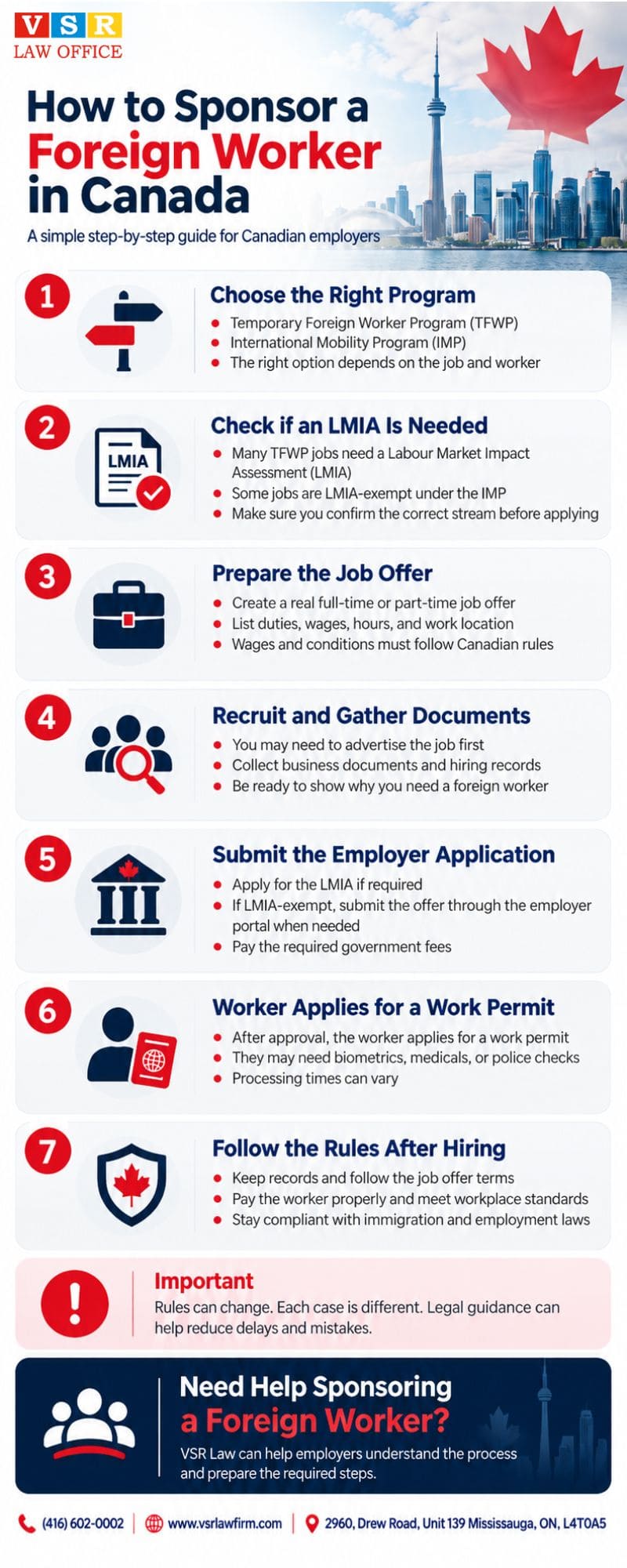
Let’s understand how to sponsor a foreign worker: and receive a spouse visa in Canada for students–
Labour Market Impact Assessment
Before recruiting foreign labour, firms must typically obtain government approval. The process now uses a Labour Market Impact Assessment (LMIA), which was formerly known as a Labour Market Opinion (LMO). A Canadian business can apply for an LMIA when it cannot find a qualified Canadian worker to fill the position. If the application meets the requirements, the government may issue an LMIA.
The primary method of establishing this is by posting job openings in Canada, and it is to make an effort to recruit Canadians. Therefore, it demonstrates that the candidates lack the necessary skills for the position being provided.
There are two categories—high-wage and low-wage. They will used to classify job positions under the new LMIA system. Jobs deemed high if the pay is at or above the provincial median wage where they will done, and it is considered low if it is lower than the provincial median wage.
How to Hire if an LMIA is Required
Thanks to the Temporary Foreign Worker Program (TFWP), you can hire. To fill labour and talent shortages, you can employ temporary foreign workers. You must deliver a copy of the confirmation letter after issuing the LMIA. Every temporary foreign worker will receive this. Then, each of them must apply for a work permit.
Also Read: Notary Public vs. Lawyer: Which is Right for Your Legal Needs?
How to Make a Hire Without an LMIA
You can also hire temporary foreign workers without an LMIA under the International Mobility Program (IMP). If you use this application to hire a worker and for spouse visa Canada requirements, you must
- Pay a compliance charge to the employer
- Submitting a job offer form via the employer portal
Sponsorship Accord
Notably, the sponsor must consent to provide the temporary worker with financial support. This applies if their relative is unable to meet their own needs. This will ensure the new inhabitant won’t need any help from the government. The person sponsored determines how long this financial commitment will last:
3 years as a spouse, common-law spouse, or romantic partner
-
- Dependent children: 10 years OR until the child becomes 22 (whichever occurs first); dependent children over 22: 3 years.
- Age of a parent or grandparent: 20
It should noted that even if the sponsored individual becomes a citizen, this financial responsibility still exists. This unaffected even if the applicant moves out of Canada or a divorce or legal separation from the sponsor. This is all done within the stipulated spouse visa Canada processing time.
What does this entail for individuals seeking work visas to enter Canada?
Despite the energy sector crisis, Canada has one of the lowest jobless rates in the world. Numerous sectors of the economy are scrambling to fill open positions. Among the labour shortages are:
- Experts who are qualified
- Drivers of trucks
- Unskilled labourers
- Workers in general
- Nanny
VSR Law is authorised to handle legal issues with foreign employees. We well-versed in the Canadian labour market and know the professions that can readily obtain employment in Canada.
Our company can assist you in effectively licensing an employee if you work in one of the professions above. We can help you apply for a Spouse visa in Canada, and we will successfully facilitate the complete immigration procedure.
Also Read: Top Skills of a Real Estate Lawyer
FAQs:
1. Can a Canadian employer sponsor a foreign worker?
Yes. A Canadian employer may be able to hire a foreign worker if the employer and the job meet government requirements. Depending on the situation, the employer may need a Labour Market Impact Assessment (LMIA) or may qualify for an LMIA exemption.
2. What is an LMIA?
An LMIA is a document that assesses whether hiring a foreign worker will affect the Canadian labour market. A positive LMIA generally confirms that there is a need for the foreign worker and that no Canadian citizen or permanent resident is available to fill the position.
3. Does every foreign worker need an LMIA?
No. Some foreign workers can be hired without an LMIA under the International Mobility Program (IMP). For example, certain workers under international agreements or specific work permit categories may qualify for an exemption.
4. What does an employer usually have to do before applying for an LMIA?
Depending on the LMIA stream, the employer may need to advertise the position and make reasonable efforts to recruit Canadian citizens and permanent residents first. The employer must also show that the business and job offer are legitimate.
5. What information is required for an LMIA application?
An employer may need to provide information about the business, job duties, wages, working conditions, recruitment efforts and the need for the foreign worker. Supporting documents may also be required to establish that the business and employment offer are genuine.
Also Read: How a Personal Injury Lawyer in Brampton Can Help After a Car Accident
6. What happens after an employer receives a positive LMIA?
The employer normally provides the foreign worker with the required LMIA documents. The worker can then use those documents when applying for an employer-specific work permit.
7. How does an employer hire an LMIA-exempt foreign worker?
For many LMIA-exempt positions, the employer must submit an Offer of Employment through IRCC’s Employer Portal and pay the applicable employer compliance fee before the worker applies for the work permit. The current employer compliance fee is generally $230, subject to exemptions.
8. Can a foreign worker start working immediately after receiving a job offer?
Not usually. A job offer alone does not automatically give someone permission to work in Canada. The worker generally needs the appropriate work authorization, such as a valid work permit, before starting employment.
9. What responsibilities does an employer have after hiring a foreign worker?
Employers must follow the wages, occupation and working conditions stated in the approved employment arrangement. They must also comply with applicable employment laws and federal foreign-worker program requirements. Employers can be inspected and may face consequences for non-compliance.
10. Can sponsoring a foreign worker help them become a permanent resident?
In some circumstances, Canadian work experience or a qualifying job offer may assist a worker with a future permanent residence application. There are also LMIA processes specifically connected with supporting certain permanent residence applications. However, eligibility depends on the immigration program and the worker’s individual circumstances.
Disclaimer: Immigration rules and requirements can change. Employers and foreign workers should confirm the current requirements with Immigration, Refugees and Citizenship Canada (IRCC) and Employment and Social Development Canada (ESDC) before applying.
Also Read: Bankruptcy vs. Insolvency: What’s the Real Difference?