
A limited time is allowed for temporary foreign employees to remain in Canada. There are open and closed work permits available, and the length of their stay will depend on the type of permission they hold. The type of permit they have will determine how long they last, and their stay will be impacted.
Canadian immigration rules and procedures govern foreigners’ access to work permits. An open permit differs from a closed permit in several ways. A foreign worker granted an open permit has unrestricted access to the labour force, which differs significantly from a closed permit, limiting the worker to a single business.
Need help with your Canadian work permit? Contact VSR Law Firm at 416-602-0002 today!
Also Read: Bankruptcy vs. Insolvency: What’s the Real Difference?
Open Work Permits for Temporary Foreign Workers
There are some open work permits in the temporary foreign worker program, implying that they permit unrestricted access to the Canadian labour market. Closed work permits are opposed, which limit a worker to a particular employer. Open work permit durations are frequently dependent upon the outcome of another application or status.
They include pending applications for common law or spousal support. It can be a pending permanent residency application submitted following an invitation to apply. Sometimes, it happens after the expiration of a spouse’s work or study visa.
Also Read: Struggling With Debt? Contact a Bankruptcy Lawyer in Toronto
Closed Work Permits for Temporary Foreign Workers
Contrarily, closed work permits typically have stricter limitations on the length of their validity period. The maximum period depends on the kind of work being done about one closed work permit, that of the Intra-Company Transferee. Managers and executives may serve for a maximum of seven years. At the same time, five years is the maximum tenure for specialised knowledge professionals.
There is an exception when an Intra-Company Transferee reaches the end of their permitted employment period. They are free to leave Canada and continue working for the same company at the branch outside Canada. Before returning to Canada on an Intra-Company Transferee work permit, this may be for up to a year.
Also Read: How a Personal Injury Lawyer in Brampton Can Help After a Car Accident
How can you become a temporary foreign worker in Canada?
You require a work permit to enter Canada as a temporary foreign worker. Work permits come in a variety of forms.
You require a work permit to lawfully work in Canada if you are not a citizen or a permanent resident.
Before coming to Canada, you must apply for a work permit from Immigration, Refugees and Citizenship Canada (IRCC) or a Canadian visa office. Regarding these employment permits and how to apply for a work permit in Canada:
- Before applying, you must first have a work offer from a Canadian business.
- Employment and Social Development Canada (ESDC) must receive an application from the employer for a Labour Market Impact Assessment (LMIA) (ESDC).
- ESDC will decide on the hiring of a foreign worker by the company.
For various types of workers, there exist specific work permissions. For instance, there are specific work permit systems for agricultural labourers, business owners, and caretakers.
Visit the IRCC website’s Working Temporarily in Canada page for further details.
Also Read: What Documents Do You Need for a Personal Injury Claim?
How long may a temporary worker in Canada work?
You can work as a temporary employee in Canada for an unlimited time. You can work for a certain amount of time if:
- the amount of time specified on your labour market impact assessment;
- the length of time your employer needs to obtain one to recruit you;
- and the expiration date of your passport through the foreign worker’s visa application.
In Canada, begin your next opportunity. Having your loved ones by your side
It’s exhilarating and unsettling all at once to relocate for a job. Before you begin working in Canada, you must complete several tasks. It is crucial to ensure your family has the required visas or work permits. Knowing you have a skilled immigration attorney guiding you through the procedure can be beneficial. It may calm some nerves so you can concentrate on getting ready for your new chance.
Also Read: What is the difference between TRP and TRV?
FAQs:
1. How long can a Temporary Foreign Worker stay in Canada?
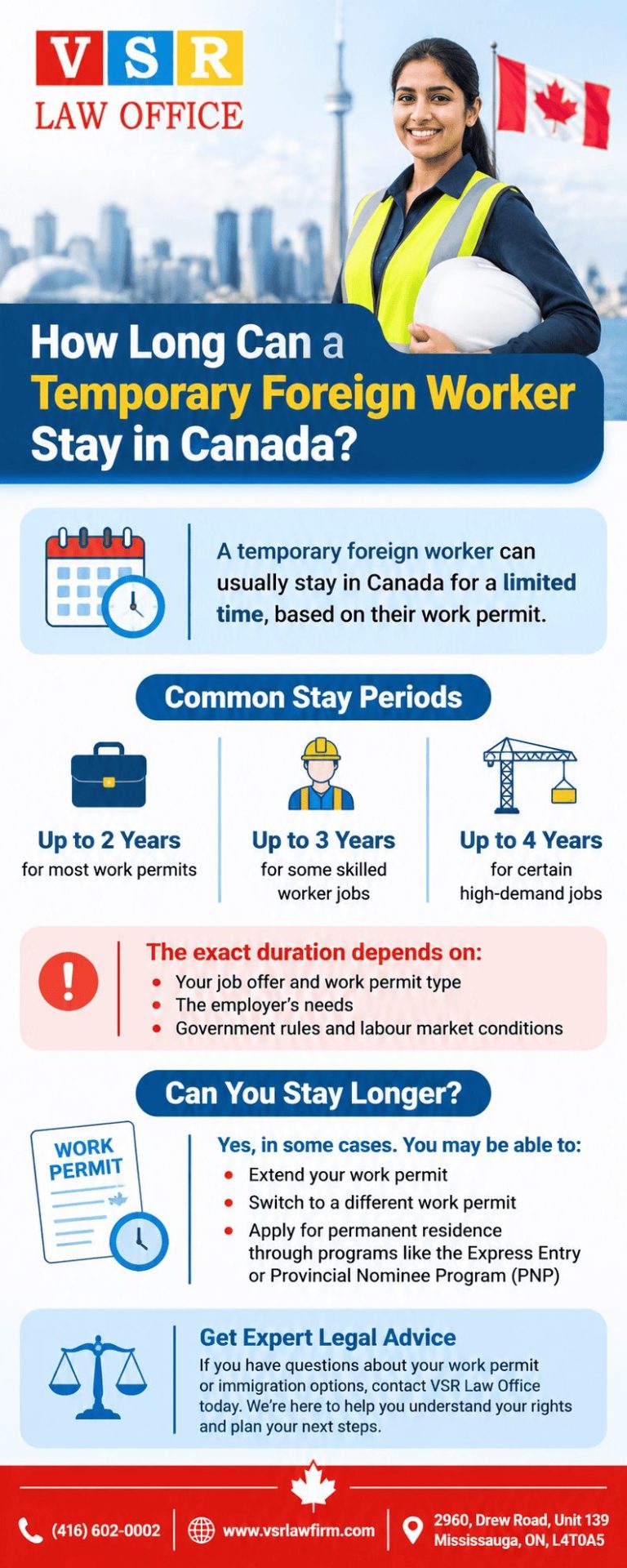
A Temporary Foreign Worker can stay in Canada for the period approved on their work permit. This can range from a few months to several years, depending on the job and permit conditions.
2. Can a Temporary Foreign Worker extend their stay in Canada?
Yes. Workers may apply to extend their work permit before it expires if they still meet the requirements.
3. What happens when a work permit expires?
If the permit expires and no extension is approved, the worker must stop working and may need to leave Canada.
4. Can I stay in Canada while my work permit extension is being processed?
Yes. If you apply before your permit expires, you may be allowed to stay and continue working under maintained status.
5. Is there a maximum number of years a Temporary Foreign Worker can stay in Canada?
The length of stay depends on the type of work permit and individual circumstances. Some workers can remain for several years through extensions.
Also Read: Avoid Legal Mistakes with a Real Estate Lawyer in Toronto
6. Can I change employers while on a temporary work permit?
In many cases, you need a new work permit before starting work for a different employer.
7. Can family members stay with me in Canada?
Yes. Eligible spouses and dependent children may be able to join you in Canada.
8. Can a Temporary Foreign Worker become a permanent resident?
Yes. Many workers use their Canadian work experience to apply for permanent residency through immigration programs.
9. What documents are needed to extend a work permit?
Common documents include a valid passport, current work permit, job offer, and other supporting documents.
10. Should I apply for an extension before my permit expires?
Yes. It is recommended to apply well before the expiration date to avoid interruptions to your work and legal status in Canada.
Also Read: Consumer Proposal vs Bankruptcy: What Canadians Need to Know
11. What are the new rules for temporary foreign workers in Canada?
Canada has introduced stricter rules for hiring temporary foreign workers. Many employers can hire only a limited number of low-wage foreign workers. The government also restricts certain job applications in cities with high unemployment rates. Some industries and rural employers have special exemptions.
12. How long can someone work in Canada with a work permit?
The length of time depends on the type of work permit and job. Some permits are valid for one year, while others may allow workers to stay for two or three years. Workers must follow the expiry date and conditions listed on their permits.
13. Can temporary foreign workers extend their work permits in Canada?
Yes. Temporary foreign workers may apply to extend their work permits if they meet the requirements. They should apply before their current permits expire. Eligible workers may continue working under the same conditions while waiting for a decision.
14. Can temporary foreign workers change employers in Canada?
Yes, but the rules depend on the work permit. Workers with an open work permit can usually change employers freely. Those with an employer-specific work permit normally need to apply for a new permit before changing employers, although early work authorization may be available.
15. Can temporary foreign workers apply for permanent residence in Canada?
Yes. Temporary foreign workers may qualify for permanent residence through programs such as Express Entry or Provincial Nominee Programs (PNPs). Eligibility depends on factors such as work experience, education, language skills, and the immigration program’s requirements. Permanent residence is not automatic.
16. Can changes to Canada’s Temporary Foreign Worker Program increase low-wage hiring?
Yes. Recent changes to Canada’s Temporary Foreign Worker Program (TFWP) may allow some employers to hire more foreign workers for low-wage jobs. Effective November 6, 2026, eligible employers in certain areas can increase their low-wage foreign worker hiring limit from 10% to 15%. However, employers must still follow government rules and make efforts to hire Canadians and permanent residents first.
Also Read: Notary Public vs. Lawyer: Which is Right for Your Legal Needs?
17. Why do some people believe the Temporary Foreign Worker Program cannot be fixed?
Some people believe the program needs major changes because of concerns about low wages, unfair treatment of workers, and limited job opportunities for Canadians. Workers with employer-specific permits may also find it difficult to leave an unfair workplace. Supporters of the program argue that it helps businesses fill important labour shortages. Better worker protection and stronger employer checks could help improve the system.
18. I have a two-year closed work permit in Canada. How can I stay permanently?
If you have a two-year closed work permit, you may be able to apply for permanent residence (PR). Common options include Express Entry, Provincial Nominee Programs (PNPs), and other eligible immigration pathways. Your options depend on your work experience, education, language skills, occupation, and province. A closed work permit does not automatically lead to permanent residence.
19. How long can I stay in Canada without overstaying my visa?
You can legally stay in Canada until your authorized temporary resident status expires. For workers and students, this is generally the expiry date shown on their permit. Visitors are usually allowed to stay for up to six months unless a different period is authorized. You should apply to extend your stay before your status expires. If you apply on time and qualify for maintained status, you may remain in Canada while your application is being processed.
20. Do days spent outside Canada as a temporary resident count as half-days toward citizenship?
No. Only eligible days you were physically present in Canada as a temporary resident or protected person before becoming a permanent resident can count as half-days toward Canadian citizenship. For example, 200 eligible days in Canada count as 100 days. You can receive a maximum credit of 365 days for time spent in Canada before becoming a permanent resident, within the relevant five-year period. Days spent outside Canada generally do not count.
Note: Immigration rules and eligibility requirements can change. Always check current Immigration, Refugees and Citizenship Canada (IRCC) guidelines before applying.
Also Read: How much Compensation do I have to pay for Personal Injury Compensation?
Need help with your Canadian work permit or immigration application? Contact VSR Law Firm at (416) 602-0002 to discuss your immigration options with our team.