

For international students from throughout the world, Canada is a preferred choice. Students come from all over the world to study at Canadian universities. Every Canadian university distinguished by its robust infrastructure, cutting-edge curriculum, and huge campuses. You must first obtain a Canadian study permit if you wish to study in Canada.
Canada is one of the top countries for higher education, attracting thousands of students each year from all over the world. Canada’s universities offer a world-class education recognized worldwide, and research considered one of the most important aspects of any graduate program. Universities assist students who come up with the most innovative research ideas, and scholarships awarded based on the research effort.
Also Read: How Long Can a Temporary Foreign Worker Stay in Canada?
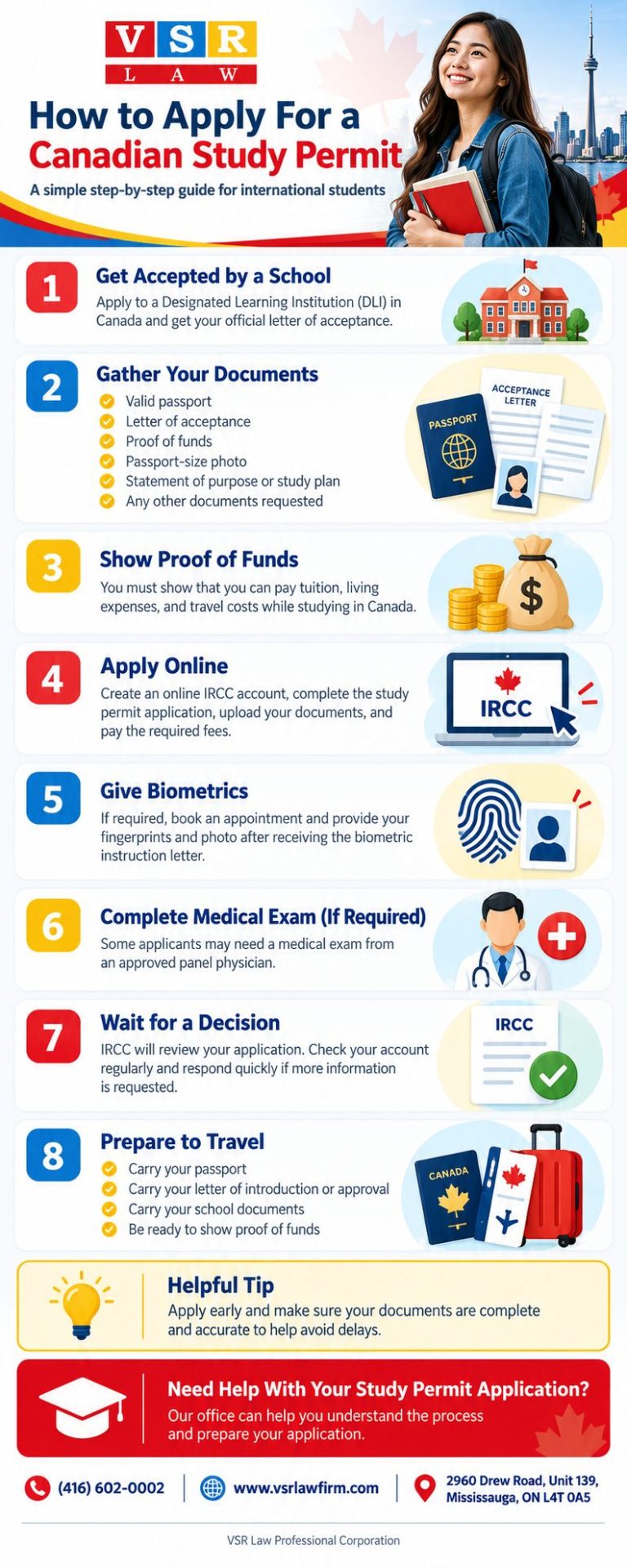
Study Permit:
A study permit allows a person to legally study at a Designated Learning Institution in Canada. A foreign national must complete eligibility requirements when applying for a study visa, and other requirements must be satisfied during the student’s stay in Canada.
Eligibility Requirement for Study Permit:
- To apply for a Canadian study permit, you must have an acceptance letter from a Designated Learning Institution (DLI).
- You must prove that you have adequate finances to cover the cost of tuition.
- Proof of cost of living (housing, food, etc.) for yourself and any accompanying family members during your first year of study. Please remember that this money may be in your name or those of a family member or close acquaintance.
- With all study permit applications, extensive supporting documentation is required. Depending on the country, different documents are required. You can visit the Immigration, Refugees, and Citizenship Canada (IRCC) website to know the documentation needed for a given location.
- You must show that you have a spotless record and have never been convicted of a crime. To demonstrate this, the candidates must present a police verification certificate.
How to apply for Canadian Study Visa?
The visa application process could take 3-4 weeks. It is recommended that you visit the website of the Canadian embassy to find out how long the student visa will take to process. Please keep in mind that the estimated time is not a guarantee.
Fill out and attach the VFS Consent Form to your application. This form required if you want VFS services to assist you with your visa application.
In-person or by mail, visa fees must paid in addition to VFS Global service charges when applying through the VFS. In such situations, the processing charge will not refunded.
Also Read: Notary Public vs. Lawyer: Which is Right for Your Legal Needs?
You must pay the relevant processing costs for your spouse/common-law partner or children if you are applying for temporary resident visas, work permits, or study permits.
You must visit your nearest VFS office to submit your application and supporting documentation. Once you’ve arrived, pay the service fees and submit your completed application for a receipt. This receipt will provide you with your unique tracking number, which you will need to check the status of your application online.
If your application accepted, the Government of Canada will send you a letter demanding your passport. In-person or via VFS, you can submit your passport and passport request letter. A Temporary Resident Visa and a Letter of Introduction will be supplied to you.
Cost of Studying in Canada:
Tuition fees vary by institution and province in Canada; however, they are generally less expensive than in other nations. The cost of technical and medical education is higher than that of arts education.
An overseas student’s tuition and fees might cost anywhere between Rs. 4,28,000 to Rs. 21,42,000 per year. A minimum bank balance of INR 6,00,000 or more for one year is necessary to apply for a Canadian student visa. The minimal amount serves as proof of money necessary to remain in the country and apply for a student visa.
Before applying, double-check that you have all of the necessary paperwork. Before travelling to Canada, you should use. You do not need a visa to study in the United States, and you cannot enter Canada due to this restriction. Visiting access or electronic travel permission may also be required, and they’ll give you one if your study permit is approved.
Also Read: Bankruptcy vs. Insolvency: What’s the Real Difference?
FAQs:
1. What is a Canadian study permit?
A Canadian study permit is a document that allows eligible foreign students to study at a Designated Learning Institution (DLI) in Canada. It is different from a visitor visa or Electronic Travel Authorization (eTA).
2. How do I apply for a Canadian study permit?
In most cases, you must apply online through Immigration, Refugees and Citizenship Canada (IRCC). Generally, you should apply before travelling to Canada. Paper applications are only available in limited situations.
3. Do I need an acceptance letter from a Canadian school?
Yes. You normally need a valid Letter of Acceptance (LOA) from a Designated Learning Institution before applying for a study permit. For post-secondary students, the school may also be required to confirm that the acceptance letter is valid.
4. What documents are required for a Canadian study permit?
Documents may include your passport, Letter of Acceptance, proof of financial support, passport photographs and, where applicable, a Provincial Attestation Letter (PAL) or Territorial Attestation Letter (TAL). Additional documents may be required depending on your circumstances and country of residence.
Also Read: Struggling With Debt? Contact a Bankruptcy Lawyer in Toronto
5. What is a PAL or TAL?
A Provincial Attestation Letter (PAL) or Territorial Attestation Letter (TAL) confirms that a province or territory has space available for you to study. Many study permit applicants need one, although some students are exempt.
6. Do master’s and PhD students need a PAL or TAL?
Starting January 1, 2026, students entering degree-granting master’s or doctoral programs at public institutions generally do not need a PAL or TAL. Different requirements may apply in Quebec.
7. How much money do I need to show for a Canadian study permit?
You must show that you can pay your tuition, living expenses and transportation costs without depending on employment in Canada. For applications submitted on or after September 1, 2026, one applicant studying outside Quebec generally needs at least $23,448 for one year of living expenses, in addition to tuition and transportation costs.
8. What can I use as proof of funds?
Examples can include bank statements, proof of tuition payments, education loans, scholarships, Canadian bank accounts, Guaranteed Investment Certificates (GICs), employment income or financial support from parents or another sponsor. IRCC may also look at where the money came from and whether it is genuinely available to you.
9. Will I need biometrics or a medical examination?
Many applicants are required to provide biometrics, which normally means fingerprints and a photograph. Depending on your circumstances, IRCC may also require a medical examination or police certificate.
10. Does receiving admission to a Canadian school guarantee my study permit?
No. A Letter of Acceptance does not automatically guarantee approval. An immigration officer will review whether you meet the study permit requirements, including your financial situation, admissibility and whether your application satisfies Canadian immigration requirements.
Disclaimer:
Immigration rules and financial requirements can change. Applicants should review the latest requirements from Immigration, Refugees and Citizenship Canada (IRCC) before applying.
Also Read: Top Skills of a Real Estate Lawyer